
Non-performing assets of banks have been on the rise for past several months due to slowdown in the economy.


'We are in a position to start due diligence and private data room access shortly.'

There is not much bank employees can do, but some words of encouragement from the management would have helped. Stretched working hours and the tense atmosphere is taking a toll on their health.

The more things change, the more they remain the same for corporate India. In the April-June 2025 period (Q1FY26) - for the ninth consecutive quarter - listed companies witnessed only single-digit revenue growth, while their core earnings, excluding other income and one-time gains, contracted for the second time in four quarters. This comes as firms brace for the impact of 50 per cent US tariff on Indian goods.

A section of the public sector banking employees will go on two-day all-India strike from Wednesday to protest against financial sector reforms and outsourcing of jobs.

With demand for information-technology (IT) services in North America still sluggish, Europe has become a source of optimism for Indian companies because it is delivering steady gains over the past two years and continuing to outperform in the latest quarter. Yet analysts caution a full-scale revival will require a rebound in the United States (US), particularly in manufacturing, retail, and BFSI (banking, financial services, and insurance), because Europe contributes only about a third of the revenues.

Investors may wait for six months and then take another look at the stock.
The gross non-performing assets of banks may rise to 13.5 per cent by September 2021, from 7.5 per cent in September 2020, under the baseline scenario, according to Financial Stability Report (FSR) released by the Reserve Bank of India.

The rally followed the govt's plan to bolster state-owned lenders.

The Indian government has introduced a bill in the Lok Sabha to ban online games played with money, aiming to curb addiction, money laundering, and financial fraud. The bill also targets advertisements and financial transactions related to such games.

The Cabinet on Wednesday gave in-principle approval for strategic disinvestment along with transfer of management control in IDBI Bank in line with the Budget announcement earlier this year. The central government and LIC together own more than 94 per cent equity of IDBI Bank. LIC, currently the promoter of IDBI Bank with management control, has a 49.21 per cent stake. The Cabinet Committee on Economic Affairs chaired by Prime Minister Narendra Modi approved the strategic sale of IDBI Bank, an official statement said on Wednesday.

Addressing the 74th Annual General Meeting of the Indian Banks' Association (IBA), she said the industry needs to imagine how Indian banking has to be in the immediate and long-term future. As far as the long-term future is concerned, she said it is going to be largely driven by digitised processes and there is a need for seamless and interconnected digital systems for a sustainable future for the Indian banking industry.

The BJP had not filed till May the expenses statement for the Karnataka Assembly elections held last year in July.
Despite the Finance Minister asking public sector banks not to hike home loan rates, top private sector lender ICICI Bank, accounting for 30 per cent of home loans, has said all lenders would have to increase rates for their own survival.

Banks have written off bad loans worth Rs 10,09,511 crore during the last five financial years, finance minister Nirmala Sitharaman informed Parliament on Tuesday. The non-performing assets (NPAs), including those in respect of which full provisioning has been made on completion of four years, are removed from the balance sheet of the bank concerned by way of write-off, she said in a reply to Rajya Sabha. "Banks write off NPAs as part of their regular exercise to clean up their balance sheet, avail tax benefit and optimise capital, in accordance with RBI guidelines and policy approved by their boards.

Moody's Investors Service on Thursday said loans to retail customers, especially those to low-income borrowers, will remain most affected due to the shock caused by the coronavirus pandemic. Despite the pandemic challenges, asset quality at Indian banks has performed better than expected at the start of the outbreak, Moody's said. "Corporate loans, in particular, have performed well because banks prior to the pandemic had largely provisioned for legacy problem loans and tightened underwriting standards," Moody's vice president and senior credit officer Srikanth Vadlamani said. Addressing an online conference organised by Moody's and its affiliate Icra, Vadlamani said an increase in non-performing loans in both public and private sector banks is subdued.
Banking and insurance services were paralysed on Tuesday as their staff and officers joined public sector employees on a day-long nation-wide strike

Budget 2015 has blessed the banking sector.

As public sector bank employees started a two-day strike on Monday seeking higher wages, Finance Minister P Chidambaram said the profit of banks cannot be used only to enhance salaries because there are other obligations.
The move would retain the public sector character of these banks, as the holding company will be wholly owned by the government, finance ministry officials said. This company, in turn, will own a majority stake in the banks.

'The private sector believes that some enablers in labour-intensive sectors like apparel, toys, tourism, and media retail, can unlock a lot of jobs.'
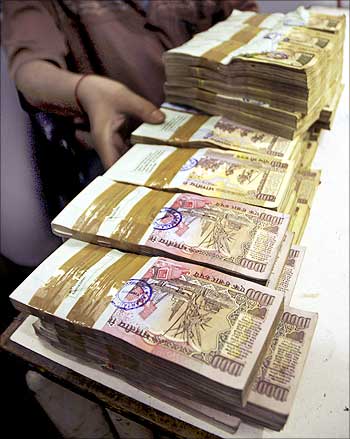
Bad loans in public sector banks more than tripled.

Letter to corporate affairs ministry cites slowing economy, capital challenges.

The outlook for India's financial sector appears bright, but it needs to brace for likely vulnerabilities, said Economic Survey 2023-24 tabled in Parliament on Monday. The Indian financial sector is at a "turnpike moment", it said, adding that the dominance of banking support to credit is being reduced, and the role of capital markets is rising. For a country that aspires to be a developed nation by 2047, this is a long-awaited and welcome development, it said.

Strike is total, impacts all branches of PSU and private banks. Clearing operation at RBI also hit.

The size of Reserve Bank's balance sheet increased by 11.08 per cent to Rs 70.47 lakh crore as on March 2024, leading to the highest-ever dividend payout to the government, according to the central bank's annual report. In actual terms, the increase was Rs 7,02,946.97 crore over Rs 63.45 lakh crore as on March 2023.

Banks, including country's largest lender State Bank of India, have informed the customers well in advance about the likely inconvenience due to strike.

At present, 58 per cent of the population has bank account.

Benefiting from higher credit off-take and loan repricing, listed commercial banks are expected to post 43.9 per cent year-on-year (YoY) growth in their net profit in the quarter ended June 30 (Q1FY24), analysts have said. Controlled credit costs due to a healthy asset quality profile and a steady treasury book will also support a strong bottom line for the lenders in the first quarter. However, net profit may shrink sequentially, according to analysts' estimates for 13 banks sourced from Bloomberg data.

Overall market reaction to the Budget was neutral. Investors absorbed the changes to the tax rates (positive for salaried class) and capital gains taxes (CGTs, negative due to the removal of indexation and increases. Other proposals largely pertain to supporting rural development, buybacks taxed as dividends, Custom duty changes that impact multiple sectors, higher outlays for clean energy, etc. There's some moderation in the growth of capex outlay across defence, fer

The global turmoil in the banking sector has made analysts cautious, who advise that investors stay away from stocks of this sector till the overall sentiment improves. The recent trouble for the banking sector started with the collapse of US-based Silicon Valley Bank (SVB), Silvergate Capital and Signature Bank. On its part, Moody's Investors Service has also cut its outlook for the US banking system to 'negative' from 'stable', citing the run on deposits at these three banks that led to the collapse of these banking majors in less than a week.
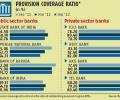
Amid a rise in non-performing assets, most public sector banks have seen a substantial drop in their provision coverage ratio in the year since the reserve Bank of India (RBI) withdrew the 70 per cent provision coverage ratio norm.

Adani group is on track to surpass a combined Ebitda (earnings before interest, taxes, depreciation, and amortisation) of Rs 1 trillion in the ongoing financial year (FY25) as it prepares for a $2 billion (over Rs 16,700 crore) share sale by its flagship entity Adani Enterprises next month, according to a source close to the matter.

RBI said the improvement in asset quality was driven by state-run lenders which saw a drop both in both GNPA and in the net NPA ratios.

Banks recovered Rs 18,933 crore (Rs 189.33 billion) worth of bad loans during the April-December period.

The government's step to curtail fiscal deficit is helping the central bank's monetary policy, Rajan said.
Imagine a tiny automated teller machine (ATM) that could be carried anywhere in your bag. Unusual it may sound, but Gujarat will soon have such small ATMs. In a novel initiative to make rural banking hassle-free, public-sector bank Dena Bank is gearing up to roll out these little ATMs in a couple of rural areas on experimental basis.
